
Gradient Descent
Understanding the Concept of Gradient Descent
Before learning the mathematical calculations and Python implementation of Gradient Descent, it is important to understand the core idea behind how Gradient Descent actually works.
Gradient Descent is an optimization algorithm used to reduce prediction error in Machine Learning models. The main goal of Gradient Descent is to find the best parameter values that produce minimum error.
Suppose a machine learning model initially makes poor predictions because the model parameters are randomly selected. Gradient Descent helps improve these parameters step by step until the model predictions become more accurate.
Real-Life Analogy
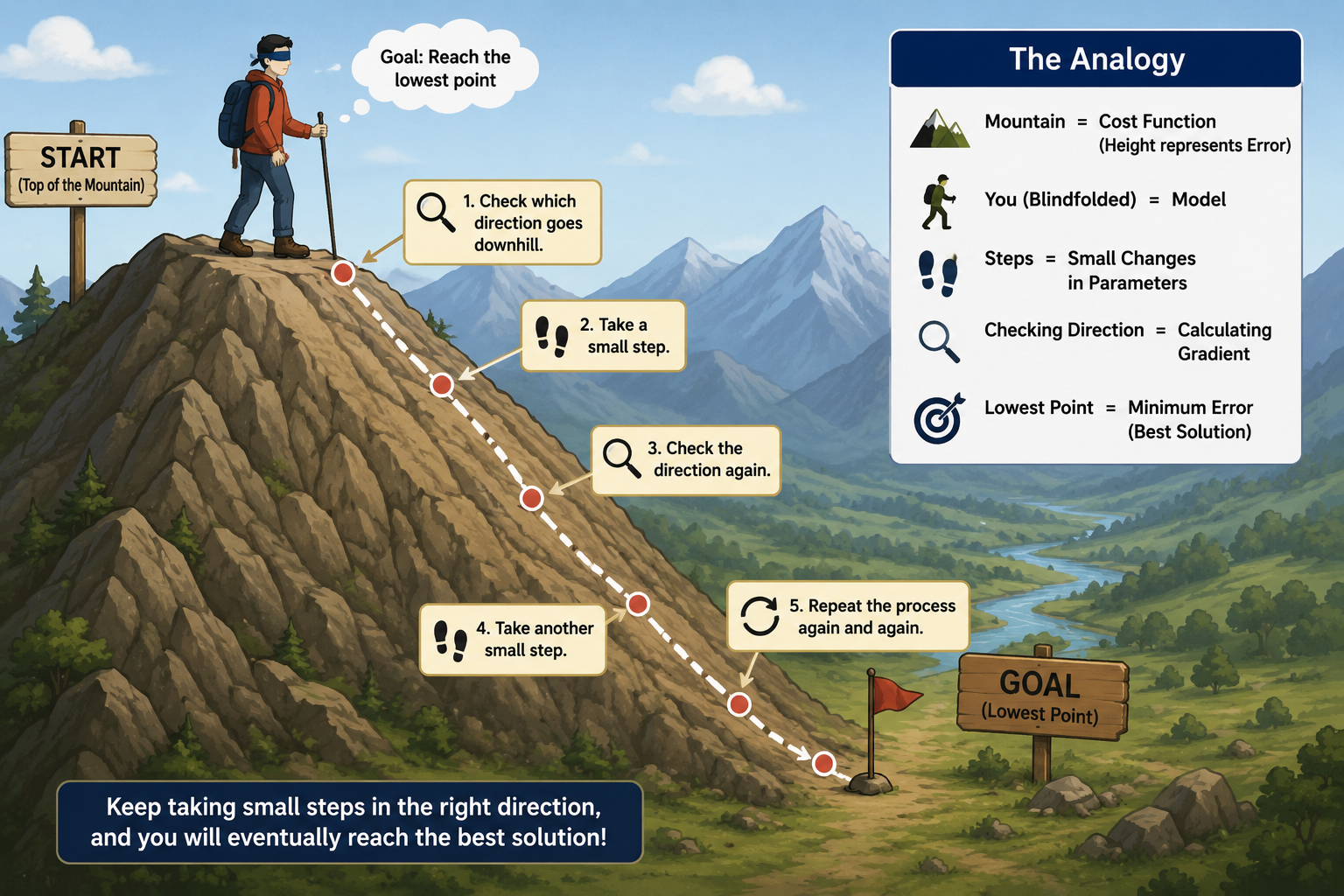
Imagine you are standing on top of a mountain blindfolded and your goal is to reach the lowest point of the valley.
You cannot directly jump to the bottom. Instead, you:
-
Check which direction goes downward
-
Take a small step
-
Again check the direction
-
Continue moving downward step by step
Eventually, you reach the lowest point.
Gradient Descent works exactly in the same way.
Instead of:
Finding the lowest point of a mountain
it tries to:
Find the minimum prediction error
Components
1. Cost Function Curve
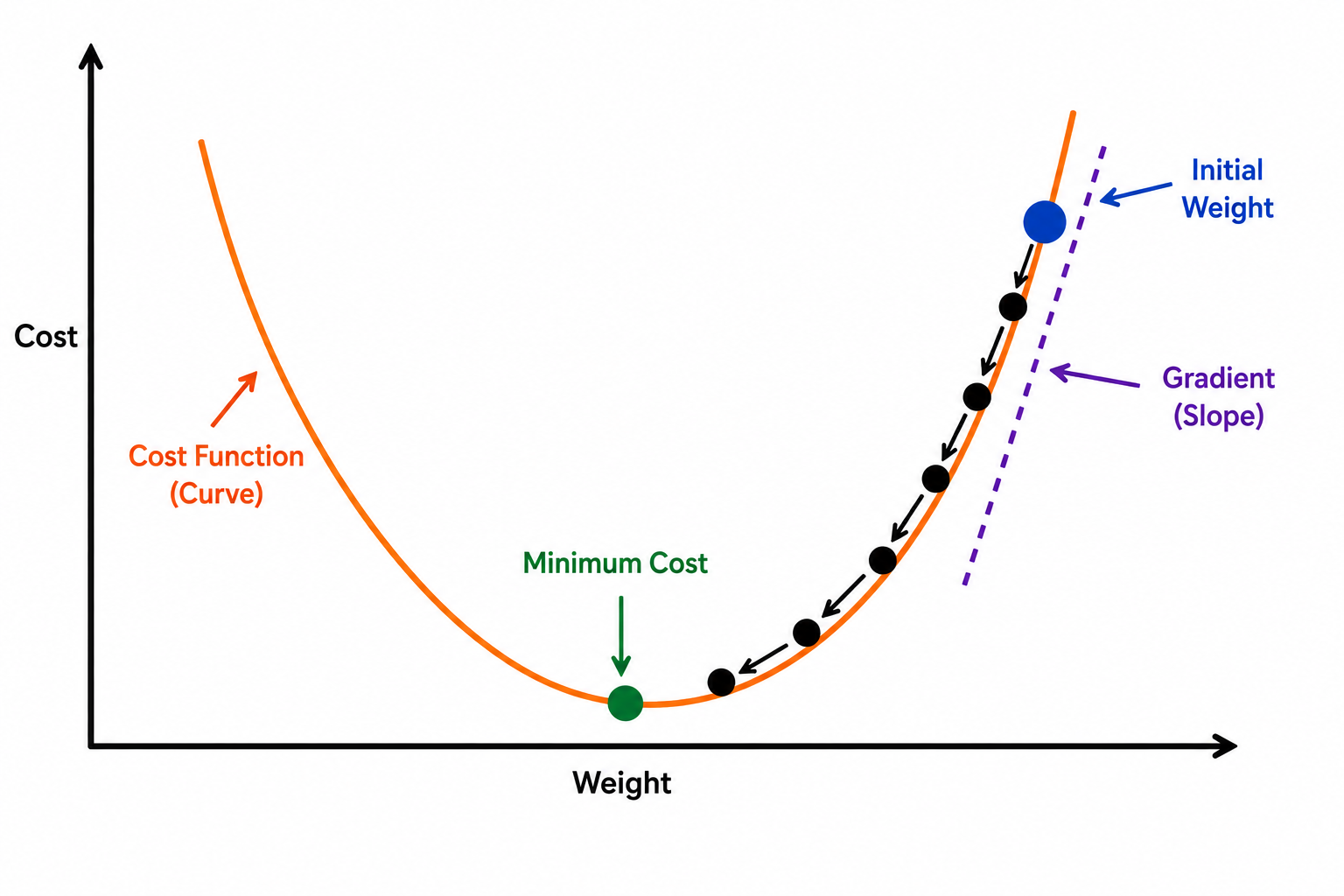
The orange curved line represents the Cost Function.
The Cost Function shows how much prediction error exists for different weight values.
Higher points on the curve indicate:
Higher prediction error
Lower points indicate:
Lower prediction error
The main objective of Gradient Descent is to reach the lowest point on this curve.
2. Initial Weight
The blue point represents the initial weight or starting parameter value selected randomly by the model.
At the beginning:
-
The model does not know the correct parameter values
-
Prediction error is usually high
So the model starts learning from this point.
3. Gradient
The dashed purple line represents the Gradient.
Gradient means:
Slope of the cost function
The gradient tells the model:
-
Which direction increases error
-
Which direction decreases error
Gradient Descent uses this information to move toward lower error.
4. Iterative Steps
The black arrows and dots represent iterative parameter updates.
The model:
-
Takes small steps
-
Updates parameter values repeatedly
-
Slowly moves toward minimum error
Each step tries to reduce prediction error further.
5. Minimum Cost Point
The green point represents the minimum cost or optimal solution.
At this point:
-
Prediction error is minimum
-
The model performs best
-
Optimal parameter values are found
This is the final destination of Gradient Descent.
Gradient Descent always moves:
Opposite to the gradient direction
because:
-
Gradient points toward increasing error
-
We want decreasing error
So the algorithm moves downward toward minimum cost.
Learning Rate
The size of each step is controlled by the Learning Rate.
Small Learning Rate
Small steps
Slow learning
Large Learning Rate
Very large steps
May skip the minimum point
Choosing the correct learning rate is very important.
Iterative Learning Process
Gradient Descent continuously repeats the following steps:
1. Predict output
2. Calculate error
3. Compute gradient
4. Update parameters
5. Repeat
until:
Minimum error is reached
Summary
Gradient Descent is a step-by-step optimization algorithm used to minimize prediction error by continuously updating model parameters until the best solution is found.