AI in Education
AI in Education: Personalized Learning at Scale
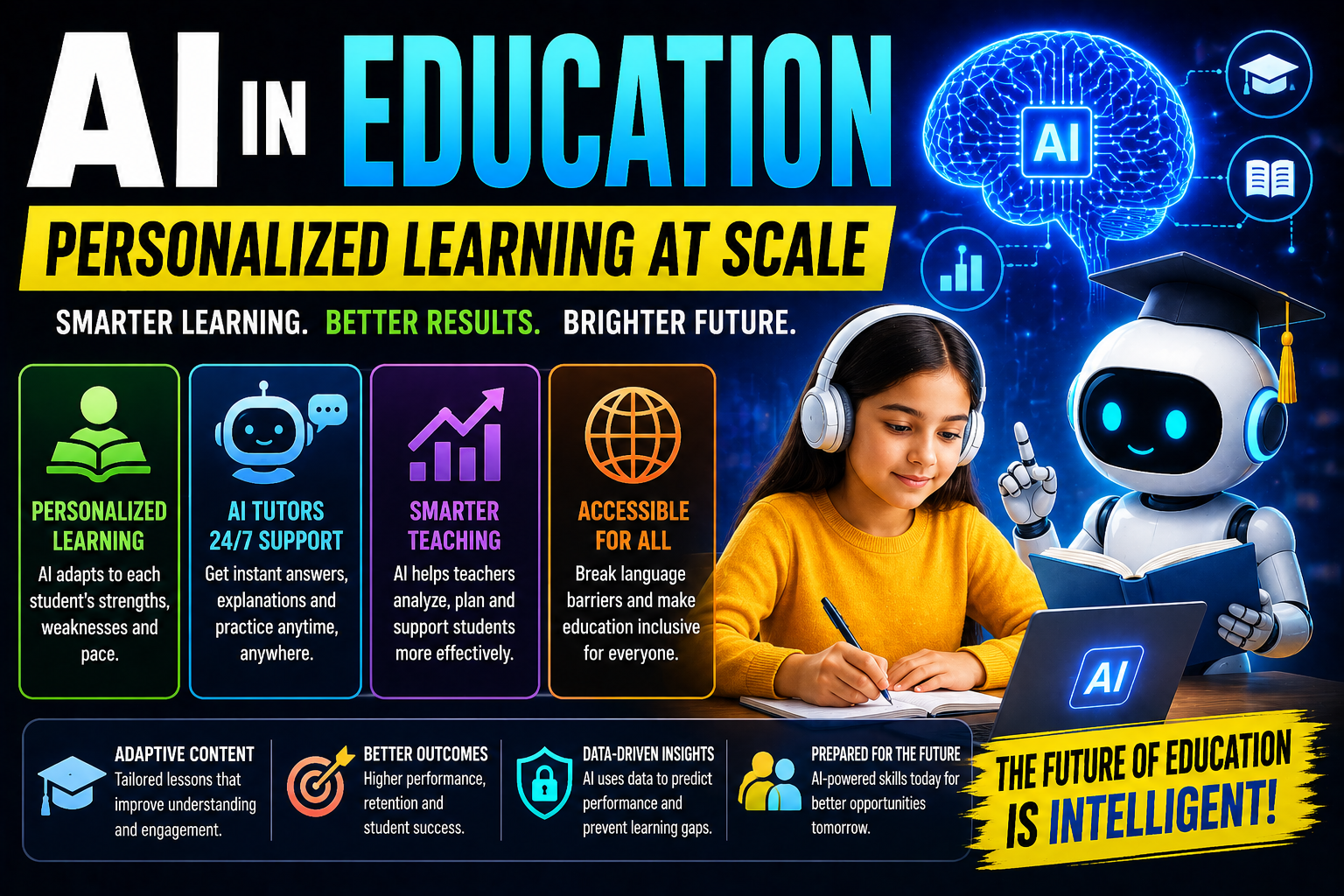
Artificial Intelligence is transforming education by making learning more personalized, accessible, and efficient. Traditional classrooms often follow a one-size-fits-all approach, but AI is helping educators adapt learning experiences to individual student needs.
In 2026, AI is becoming one of the most powerful technologies shaping the future of education.
Personalized Learning for Every Student
Every student learns differently. Some learn faster, while others need additional support.
AI helps by:
- Tracking learning progress
- Identifying strengths and weaknesses
- Adapting lessons based on performance
This creates a more personalized learning experience for each student.
AI-Powered Virtual Tutors
AI tutors are becoming increasingly popular in digital learning platforms.
They can:
- Answer student questions instantly
- Explain difficult concepts
- Provide practice exercises
- Offer 24/7 learning support
This allows students to learn anytime and at their own pace.
Smarter Classrooms with AI
Modern classrooms are becoming more intelligent through AI integration.
AI systems help teachers:
- Analyze student performance
- Automate grading
- Track attendance
- Identify students who need extra support
This reduces administrative work and allows teachers to focus more on teaching.
Improving Accessibility in Education
AI is making education more accessible to students worldwide.
Technologies include:
- Real-time language translation
- Speech-to-text systems
- AI-powered learning assistants
- Accessibility tools for students with disabilities
This helps create more inclusive learning environments.
AI and Online Learning Platforms
Online learning platforms use AI to improve user experiences.
AI helps:
- Recommend courses
- Personalize content
- Suggest learning paths
- Improve engagement
This keeps students motivated and improves learning outcomes.
Data-Driven Education
AI allows educational institutions to make better decisions using data.
Schools and universities can:
- Predict student performance
- Reduce dropout rates
- Improve curriculum planning
- Optimize learning strategies
This creates a more efficient education system.
Challenges of AI in Education
Despite its advantages, AI also raises concerns:
- Data privacy for students
- Dependence on technology
- Reduced human interaction
- Unequal access to AI tools
Balancing technology with human teaching remains important.
The Future of Learning
The future of education will likely combine:
- Human teachers
- AI tutors
- Virtual classrooms
- Interactive learning systems
AI will not replace teachers, but it will enhance the learning experience significantly.
Summary
AI is reshaping education by making learning smarter, faster, and more personalized.
As technology continues to evolve, AI has the potential to make high-quality education accessible to millions worldwide.
The future of learning is not just digital—it is intelligent.
Keywords:
AI in education, personalized learning, AI tutors, artificial intelligence in schools, future of education, smart classrooms, online learning AI
Tags:
AI Education, Personalized Learning, Artificial Intelligence, Smart Learning, EdTech, Online Education, Future Technology