The Current AI
The Current AI : What Has Changed and What Matters Now
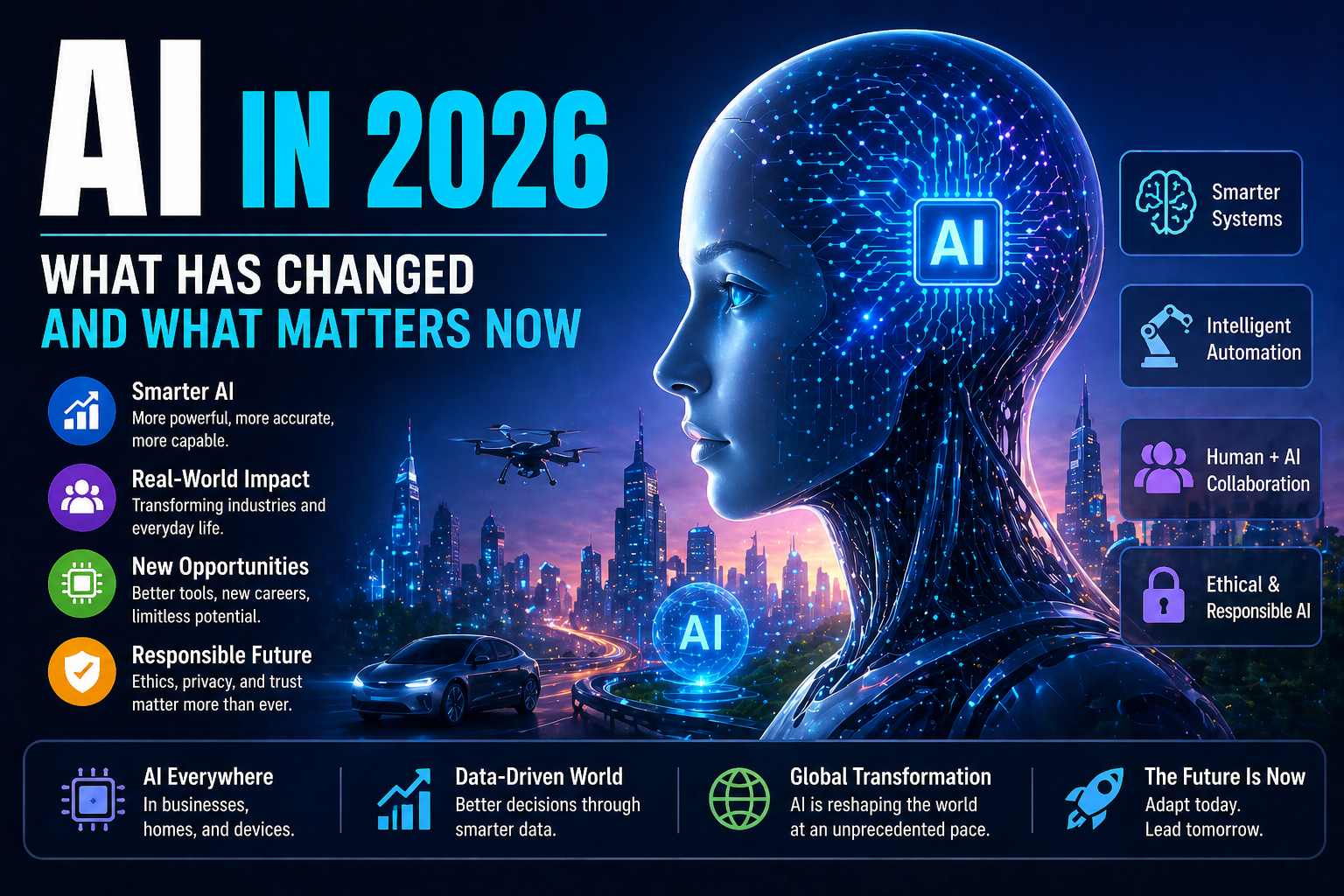
Artificial Intelligence has evolved rapidly over the past few years, but 2026 marks a turning point. AI is no longer just a tool for automation—it has become a core driver of innovation, decision-making, and global transformation.
From businesses to daily life, AI is now deeply embedded in how the world operates.
The Shift from Experimental to Essential
In the past, AI was often seen as an experimental technology. Today, it has become essential.
Companies are no longer asking “Should we use AI?”—they are asking “How fast can we implement it?”
AI is now:
- Integrated into business operations
- Driving data-based decisions
- Powering customer experiences
- Enabling automation at scale
This shift has made AI a necessity rather than a luxury.
Rise of Generative AI
One of the biggest changes in recent years is the rise of generative AI. Unlike traditional systems, generative AI can create content such as text, images, videos, and even code.
This has transformed industries like:
- Content creation
- Marketing
- Software development
- Media and entertainment
Generative AI is not just assisting creativity—it is accelerating it.
AI Is Becoming More Accessible
Earlier, AI was limited to large tech companies. In 2026, it is accessible to everyone.
Today:
- Small businesses use AI tools
- Individuals automate daily tasks
- Creators use AI for content production
- Students use AI for learning
This democratization of AI is one of the biggest drivers of its growth.
The Business Impact of AI
AI is now a major competitive advantage.
Businesses are using AI to:
- Increase efficiency
- Reduce costs
- Improve customer experience
- Predict market trends
Companies that adopt AI early are outperforming those that don’t. AI is no longer optional—it defines success in the modern economy.
Human + AI Collaboration
Instead of replacing humans, AI is enhancing human capabilities.
We are entering an era where:
- AI handles repetitive tasks
- Humans focus on strategy and creativity
- Decision-making becomes data-driven
This collaboration is more powerful than either humans or machines alone.
Challenges That Still Matter
Despite its growth, AI still comes with challenges:
- Data privacy concerns
- Bias in algorithms
- Job displacement fears
- Ethical decision-making
As AI becomes more powerful, responsible usage becomes even more important.
What Matters Most in 2026
To stay relevant in the AI era, focus on:
- Understanding how AI works
- Learning to use AI tools
- Adapting to technological changes
- Developing human skills like creativity and critical thinking
The people who adapt will lead the future.
The Road Ahead
AI will continue to evolve at an incredible pace. The next few years will bring even more advanced systems, deeper integration, and new opportunities.
The real question is not whether AI will shape the future—it already is.
The question is: Are you ready for it?
Keywords:
AI 2026, Future of AI, Artificial Intelligence Trends, AI Technology, Generative AI, AI Impact, Digital Transformation, AI Growth
Tags:
AI Trends, AI 2026, Artificial Intelligence, Generative AI, Future Technology, Machine Learning, Automation, Tech Innovation