
Evolution-of-AI
The Evolution of AI: From Rule-Based Systems to Generative AI
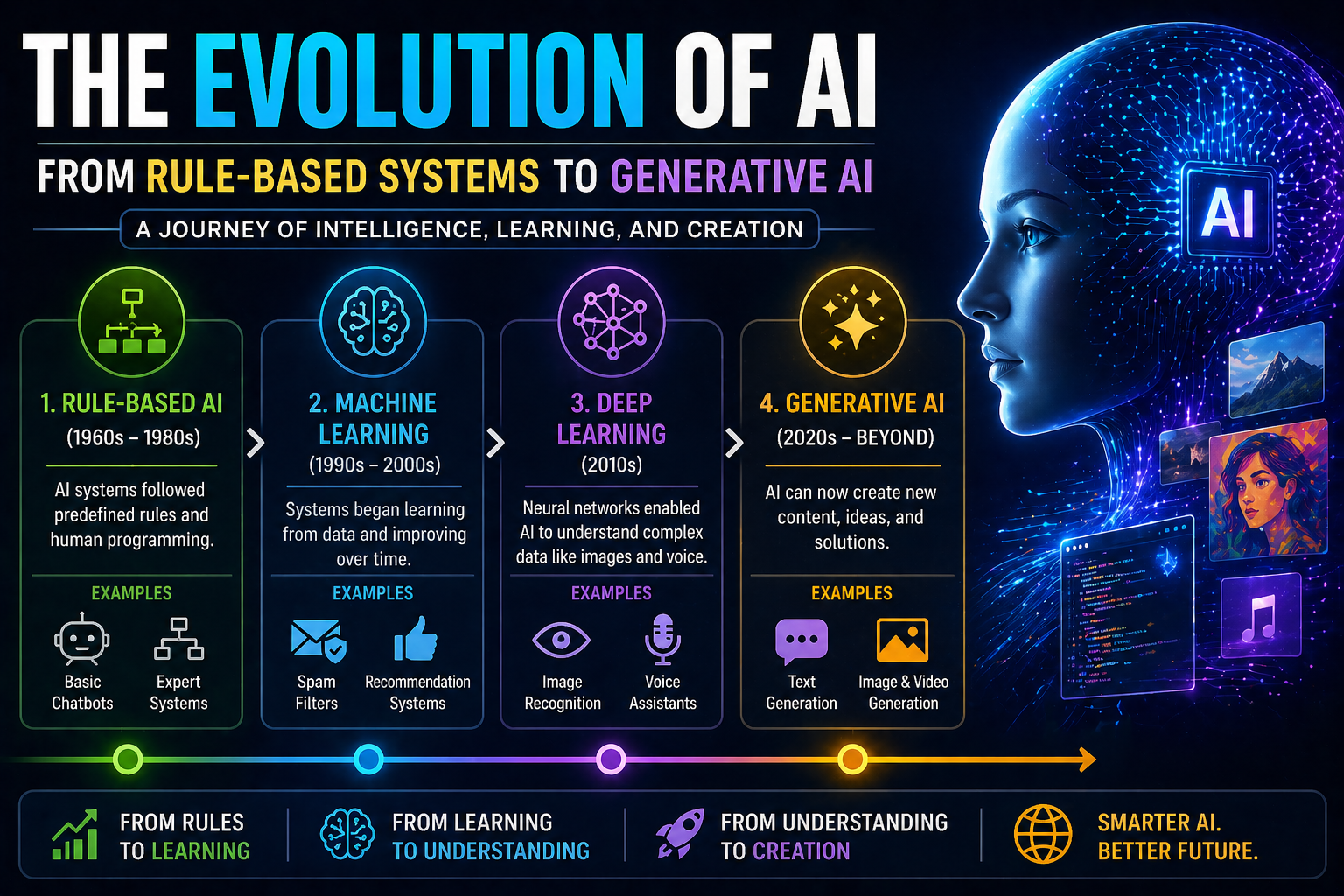
Artificial Intelligence didn’t appear overnight. It has evolved over decades—from simple rule-based systems to powerful generative models that can create content, solve problems, and assist humans in complex tasks.
Understanding this evolution helps you see where AI is headed next.
The Early Days: Rule-Based AI
The first generation of AI systems was rule-based. These systems worked using predefined logic created by developers.
They followed simple instructions like:
IF condition → THEN action
For example:
- Basic chatbots with fixed responses
- Expert systems used in early healthcare
- Simple automation tools
These systems were limited because they could not learn or adapt.
The Shift to Machine Learning
As data became more available, AI evolved into machine learning.
Instead of relying on fixed rules, systems started learning from data.
This allowed AI to:
- Recognize patterns
- Make predictions
- Improve over time
Examples include:
- Email spam filters
- Recommendation systems
- Search engines
This was a major breakthrough—AI became smarter and more useful.
The Rise of Deep Learning
The next big step was deep learning.
Inspired by the human brain, deep learning uses neural networks to process complex data such as images, speech, and text.
This enabled:
- Image recognition
- Voice assistants
- Language translation
- Self-driving technology
Deep learning made AI capable of handling real-world complexity.
The Generative AI Revolution
The most recent evolution is generative AI.
Unlike previous systems, generative AI doesn’t just analyze data—it creates new content.
It can generate:
- Text
- Images
- Code
- Music
- Videos
This is transforming industries like:
- Content creation
- Marketing
- Software development
- Design
Generative AI is pushing the boundaries of what machines can do.
Why This Evolution Matters
Each stage of AI evolution solved a major limitation:
- Rule-based AI → Could not learn
- Machine learning → Learned from data
- Deep learning → Handled complex tasks
- Generative AI → Creates new content
This progression shows how AI is becoming more powerful and more human-like in its capabilities.
The Current Phase: AI Everywhere
Today, AI is integrated into almost every industry:
- Healthcare
- Finance
- Education
- Entertainment
- Business
It is no longer a specialized tool—it is a general-purpose technology.
What’s Next?
AI is still evolving. The next phase may include:
- More advanced human-AI collaboration
- Smarter decision-making systems
- AI that understands context better
- More personalized experiences
The future of AI will be defined by how well it integrates into human life.
Summary
The journey of AI—from simple rules to intelligent creation—shows how far technology has come.
And this is just the beginning.
Understanding this evolution gives you an advantage in a world where AI is shaping the future.
Keywords:
Evolution of AI, history of artificial intelligence, generative AI, machine learning evolution, deep learning, AI development
Tags:
AI Evolution, Artificial Intelligence History, Generative AI, Machine Learning, Deep Learning, Tech Trends, Future Technology