
How AI Works
Inside AI: How Modern AI Systems Actually Work
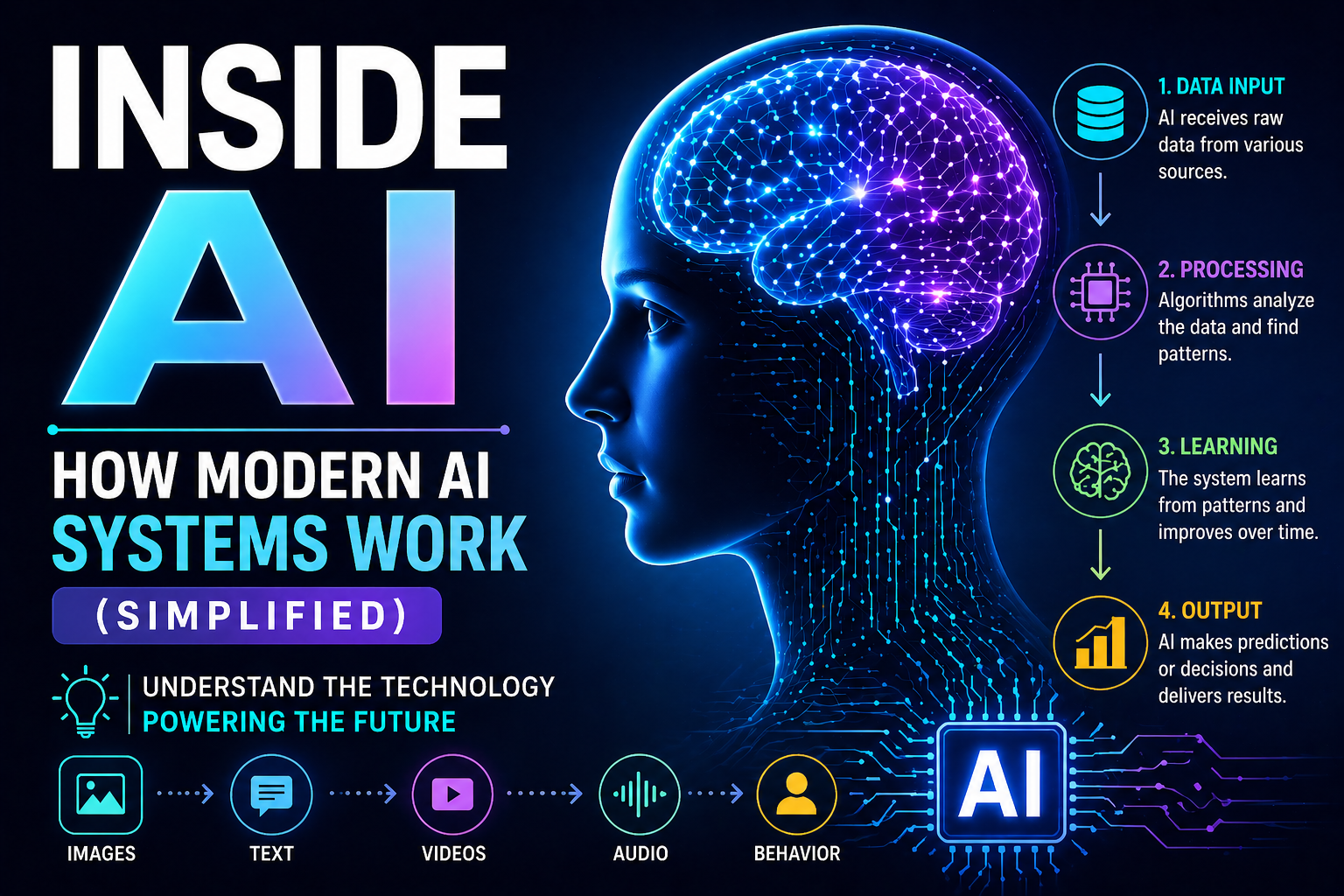
Artificial Intelligence may seem complex, but at its core, it works on a simple idea: learning from data and improving over time. In 2026, AI systems are more powerful than ever—but understanding how they work doesn’t have to be complicated.
The Core Idea Behind AI
AI systems are designed to simulate human intelligence. They don’t “think” like humans, but they can analyze patterns, learn from examples, and make decisions based on data.
Instead of being explicitly programmed for every task, modern AI learns from experience.
The Role of Data
Data is the foundation of AI.
AI systems are trained using large amounts of data such as:
- Text
- Images
- Videos
- User behavior
The more high-quality data an AI system has, the better it performs. Poor data leads to poor results—this is why data quality is critical.
Machine Learning: The Engine of AI
Machine learning is the core technology behind most AI systems.
It works by:
- Feeding data into algorithms
- Finding patterns within that data
- Making predictions or decisions
Over time, the system improves as it processes more data.
For example:
- A spam filter learns to identify unwanted emails
- A recommendation system learns user preferences
- A voice assistant improves speech recognition
Deep Learning: Making AI More Powerful
Deep learning is a more advanced form of machine learning. It uses neural networks inspired by the human brain.
These networks:
- Process complex data
- Recognize patterns in images and speech
- Power technologies like chatbots and image recognition
Deep learning is what enables AI to perform tasks that were once considered impossible.
Training vs Using AI
AI systems go through two main phases:
Training Phase:
The system learns from data by identifying patterns and relationships.
Inference Phase:
The system applies what it has learned to make predictions or decisions in real time.
This is why AI systems can improve over time without being reprogrammed.
Algorithms: The Decision Makers
Algorithms are the rules and logic that guide AI systems.
They determine:
- How data is processed
- How patterns are identified
- How decisions are made
Different algorithms are used depending on the task, such as classification, prediction, or recommendation.
Real-World Example
Let’s take a simple example: a video streaming platform.
- It collects data on what you watch
- It analyzes your preferences
- It recommends content you are likely to enjoy
This entire process is powered by AI working in the background.
Why Modern AI Feels “Smart”
AI feels intelligent because it can:
- Learn from experience
- Adapt to new data
- Improve accuracy over time
But it’s important to remember—AI doesn’t have consciousness or understanding. It operates based on patterns and probabilities.
Limitations of AI
Even advanced AI systems have limitations:
- They depend heavily on data
- They can make biased decisions
- They lack human judgment and emotion
- They struggle with completely new situations
Understanding these limitations helps us use AI more effectively.
Summary
Modern AI systems are powerful, but their foundation is simple: data, learning, and improvement.
Once you understand how AI works, it becomes less mysterious and more practical.
In today’s world, knowing how AI works is not just useful—it’s essential.
Keywords:
How AI works, Machine Learning, Deep Learning, AI Explained, Artificial Intelligence Basics, AI Systems, AI Technology, Data and AI
Tags:
AI Explained, Machine Learning, Deep Learning, Artificial Intelligence, AI Systems, Tech Education, Data Science, Automation