AI-vs-Software
AI vs Traditional Software: What’s the Real Difference?
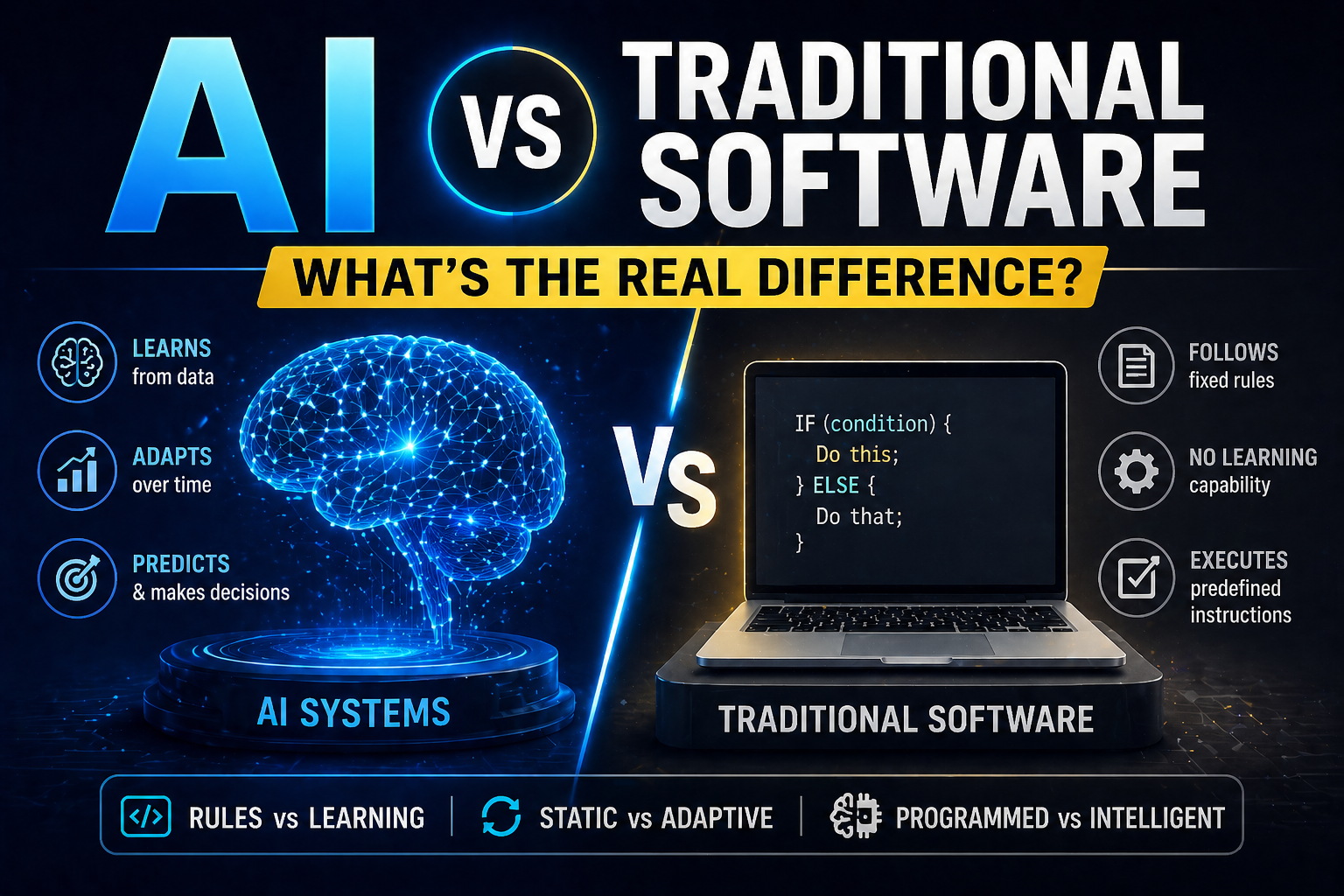
Technology has evolved rapidly, and one of the biggest shifts is the move from traditional software to Artificial Intelligence (AI). While both are powerful, they work in completely different ways.
Understanding this difference is key to knowing why AI is transforming industries so quickly.
What Is Traditional Software?
Traditional software is built using fixed rules. Developers write specific instructions, and the system follows them exactly.
For example:
- A calculator follows predefined formulas
- A billing system processes fixed inputs
- A website displays data based on programmed logic
Traditional software is predictable, consistent, and rule-based.
What Is AI-Based Software?
AI software is different. Instead of following fixed rules, it learns from data.
AI systems:
- Analyze patterns
- Improve over time
- Make predictions
- Adapt to new situations
This makes AI more flexible and powerful compared to traditional systems.
Key Difference: Rules vs Learning
The biggest difference comes down to this:
Traditional software → Works on rules
AI software → Learns from data
In traditional systems, if something changes, developers must update the code manually.
In AI systems, the software can adapt automatically by learning from new data.
Decision-Making Capability
Traditional software can only make decisions based on programmed logic.
AI, on the other hand, can:
- Predict outcomes
- Recommend actions
- Analyze complex scenarios
This is why AI is used in areas like fraud detection, recommendations, and automation.
Handling Data
Traditional systems struggle with large and unstructured data.
AI systems are designed to handle:
- Big data
- Images
- Speech
- Text
This ability makes AI suitable for modern applications like voice assistants and image recognition.
Flexibility and Adaptability
Traditional software is rigid. It does exactly what it is programmed to do—nothing more.
AI is dynamic:
- It improves with experience
- It adapts to new inputs
- It evolves over time
This flexibility is what makes AI so powerful in today’s world.
Real-World Comparison
Let’s look at a simple example:
Traditional Software:
A spam filter with fixed rules (e.g., block certain keywords)
AI-Based System:
A smart spam filter that learns from user behavior and improves accuracy over time
When to Use Traditional Software
Traditional software is still useful when:
- Tasks are simple and predictable
- Rules are clearly defined
- No learning is required
It is fast, reliable, and easier to control.
When to Use AI
AI is better when:
- Data is large and complex
- Patterns need to be discovered
- Predictions are required
- Systems must adapt over time
Summary
AI is not here to replace traditional software—it is here to extend it.
Both have their place, but AI is unlocking possibilities that traditional systems cannot achieve alone.
Understanding this difference helps you see why AI is becoming the future of technology.
Keywords:
AI vs traditional software, difference between AI and software, AI systems vs programs, machine learning vs programming, AI technology
Tags:
AI vs Software, Artificial Intelligence, Machine Learning, Software Development, Tech Comparison, Automation, Future Technology