
AI in Healthcare
AI in Healthcare: From Diagnosis to Drug Discovery
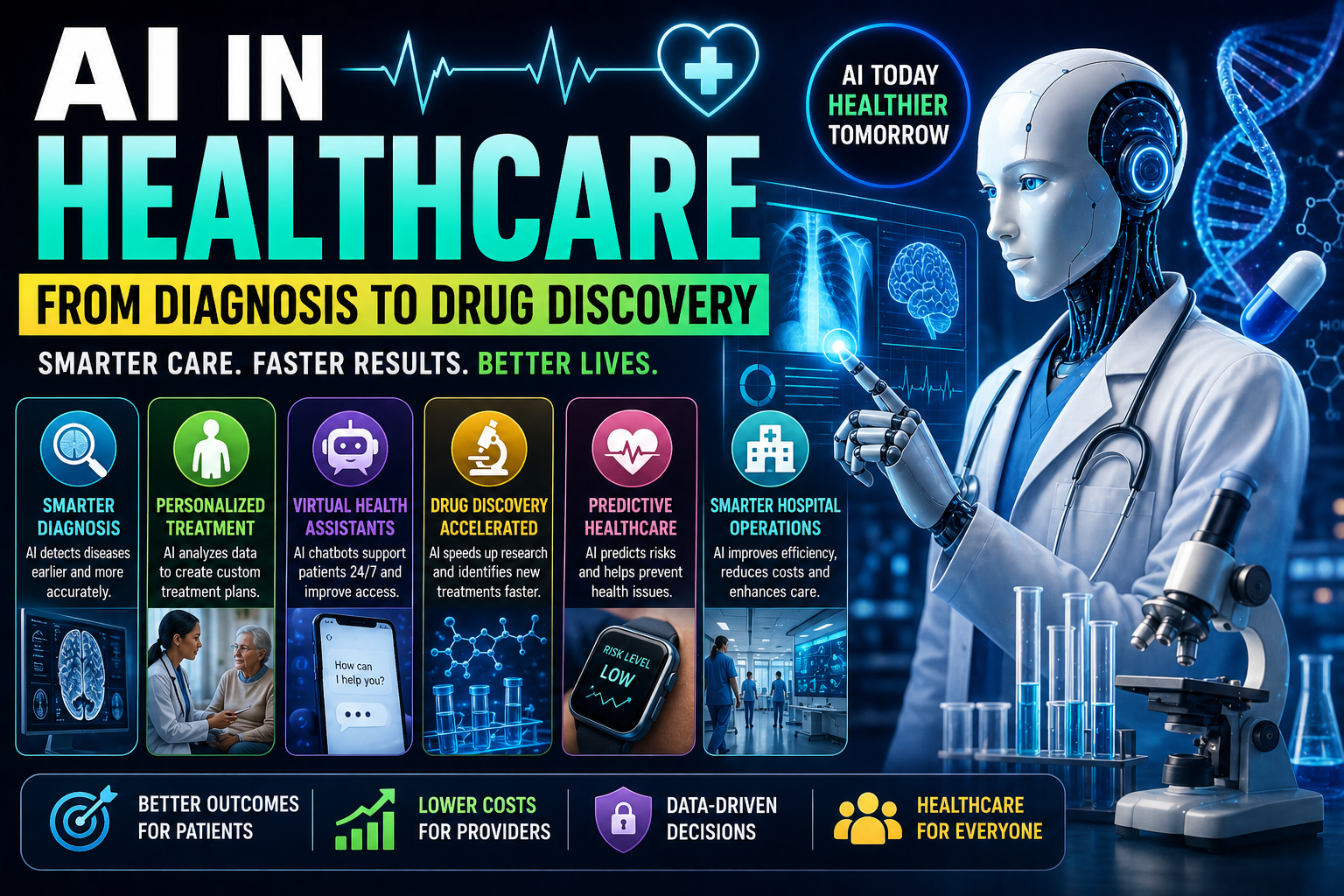
Artificial Intelligence is transforming healthcare faster than ever before. From detecting diseases early to accelerating drug discovery, AI is helping doctors, researchers, and hospitals improve patient care and save lives.
Now, AI is no longer just supporting healthcare—it is becoming a critical part of it.
Faster and More Accurate Diagnoses
One of the biggest advantages of AI in healthcare is its ability to analyze medical data quickly and accurately.
AI systems can:
- Detect diseases from scans and images
- Identify patterns in patient records
- Support doctors in diagnosis
This helps reduce errors and improves treatment outcomes.
AI in Medical Imaging
Medical imaging has become one of the most successful applications of AI.
AI helps analyze:
- X-rays
- MRI scans
- CT scans
- Ultrasounds
It can detect abnormalities faster and sometimes earlier than traditional methods.
Personalized Treatment Plans
Every patient is different, and AI is helping healthcare become more personalized.
AI systems analyze:
- Medical history
- Genetics
- Lifestyle data
- Treatment responses
This allows doctors to create customized treatment plans for better results.
AI-Powered Virtual Health Assistants
Virtual assistants and AI chatbots are improving patient support.
They help with:
- Appointment scheduling
- Medication reminders
- Symptom checking
- Basic medical guidance
This improves accessibility and reduces pressure on healthcare systems.
Drug Discovery and Research
Developing new medicines traditionally takes years and costs billions.
AI is accelerating this process by:
- Analyzing chemical compounds
- Predicting drug effectiveness
- Identifying potential treatments faster
This can significantly reduce research time and cost.
Predictive Healthcare
AI can help predict health risks before serious problems occur.
By analyzing patient data, AI can identify:
- Early signs of disease
- Risk factors
- Possible complications
This enables preventive healthcare instead of reactive treatment.
AI in Hospital Management
Hospitals are using AI to improve operations and efficiency.
AI helps with:
- Managing patient flow
- Optimizing staff schedules
- Reducing wait times
- Monitoring equipment usage
This improves both patient experience and hospital performance.
Challenges and Ethical Concerns
Despite its benefits, AI in healthcare also raises important concerns:
- Data privacy and security
- Bias in medical algorithms
- Dependence on technology
- Ethical decision-making
Responsible implementation is essential to ensure patient safety and trust.
The Future of AI in Healthcare
The future of healthcare will become more intelligent, connected, and data-driven.
We can expect:
- Smarter diagnostics
- AI-assisted surgeries
- Advanced robotic healthcare systems
- Faster medical breakthroughs
AI has the potential to make healthcare more efficient, affordable, and accessible worldwide.
Summary
AI is revolutionizing healthcare by improving diagnosis, treatment, research, and patient care.
While challenges remain, the opportunities are enormous.
The combination of human expertise and AI technology could reshape the future of medicine for generations to come.
Keywords:
AI in healthcare, artificial intelligence in medicine, AI diagnosis, AI drug discovery, medical AI, healthcare technology, AI medical imaging
Tags:
AI Healthcare, Artificial Intelligence, Medical Technology, Healthcare Innovation, AI Diagnosis, Future Medicine, Digital Health