
Logistic Regression
Logistic Regression is a supervised machine learning algorithm used for classification problems.
Unlike Linear Regression:
Which predicts continuous values
Logistic Regression predicts:
Categories or classes
Real-Life Examples
| Application | Prediction |
|---|---|
| Email Spam Detection | Spam / Not Spam |
| Disease Prediction | Disease / No Disease |
| Loan Approval | Approved / Rejected |
| Student Result | Pass / Fail |
Why Logistic Regression is Needed
Suppose we want to predict:
Whether a student pass or fail
Possible outputs are:
0 → Fail
1 → Pass
Linear Regression is not suitable because:
-
It predicts continuous values
-
Output may become less than 0 or greater than 1
Logistic Regression solves this problem.
Output of Logistic Regression
Logistic Regression predicts:
Probability values
between:
0 and 1
Example:
| Probability | Prediction |
|---|---|
| 0.90 | Pass |
| 0.20 | Fail |
Logistic Function (Sigmoid Function)
Logistic Regression uses the Sigmoid Function.
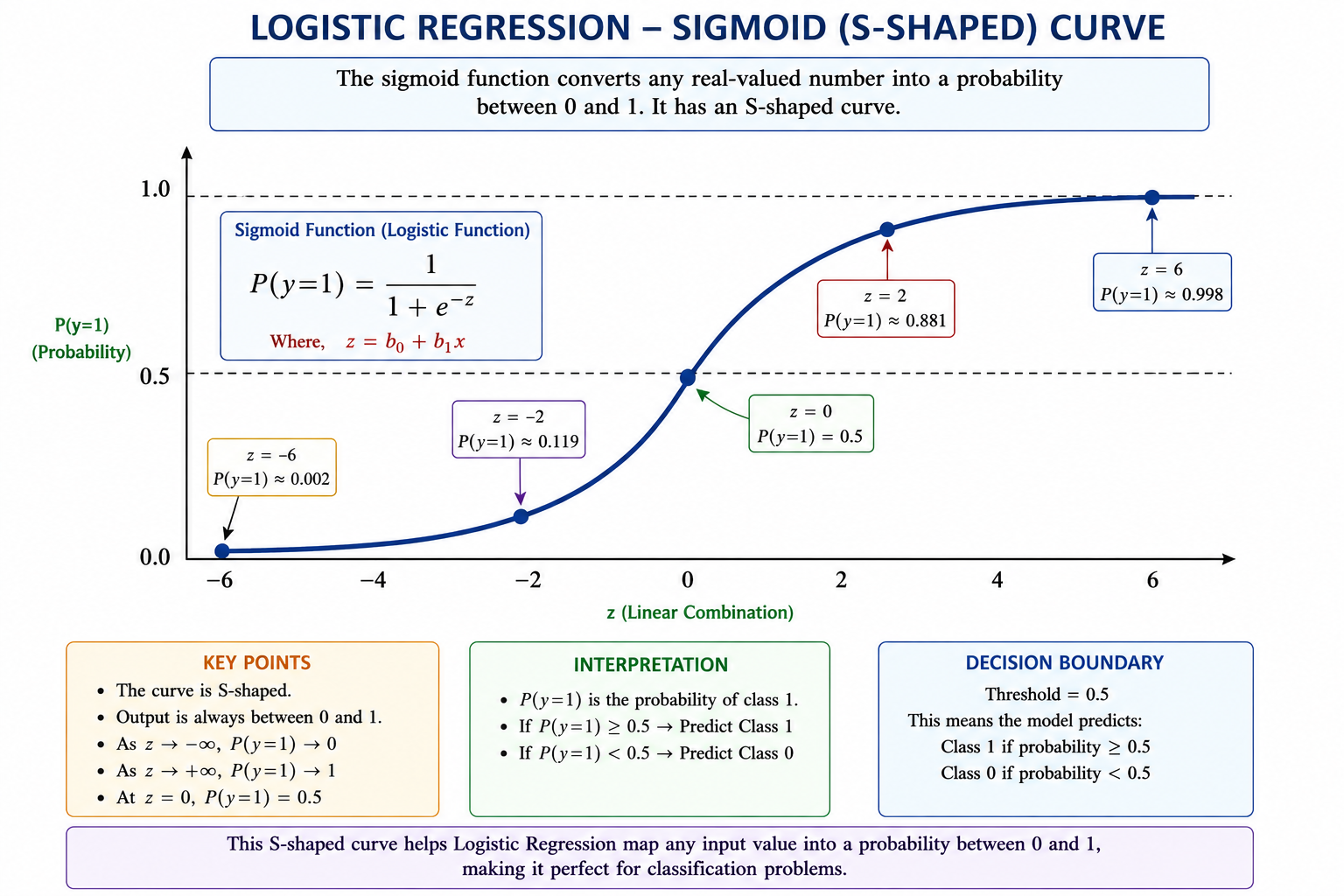
The sigmoid function converts values into probabilities.
Sigmoid Function Formula
P(y) = 1 / (1 + e^-z)
Where:
z = b0 + b1x
Understanding Sigmoid Curve
The sigmoid function produces an S-shaped curve.
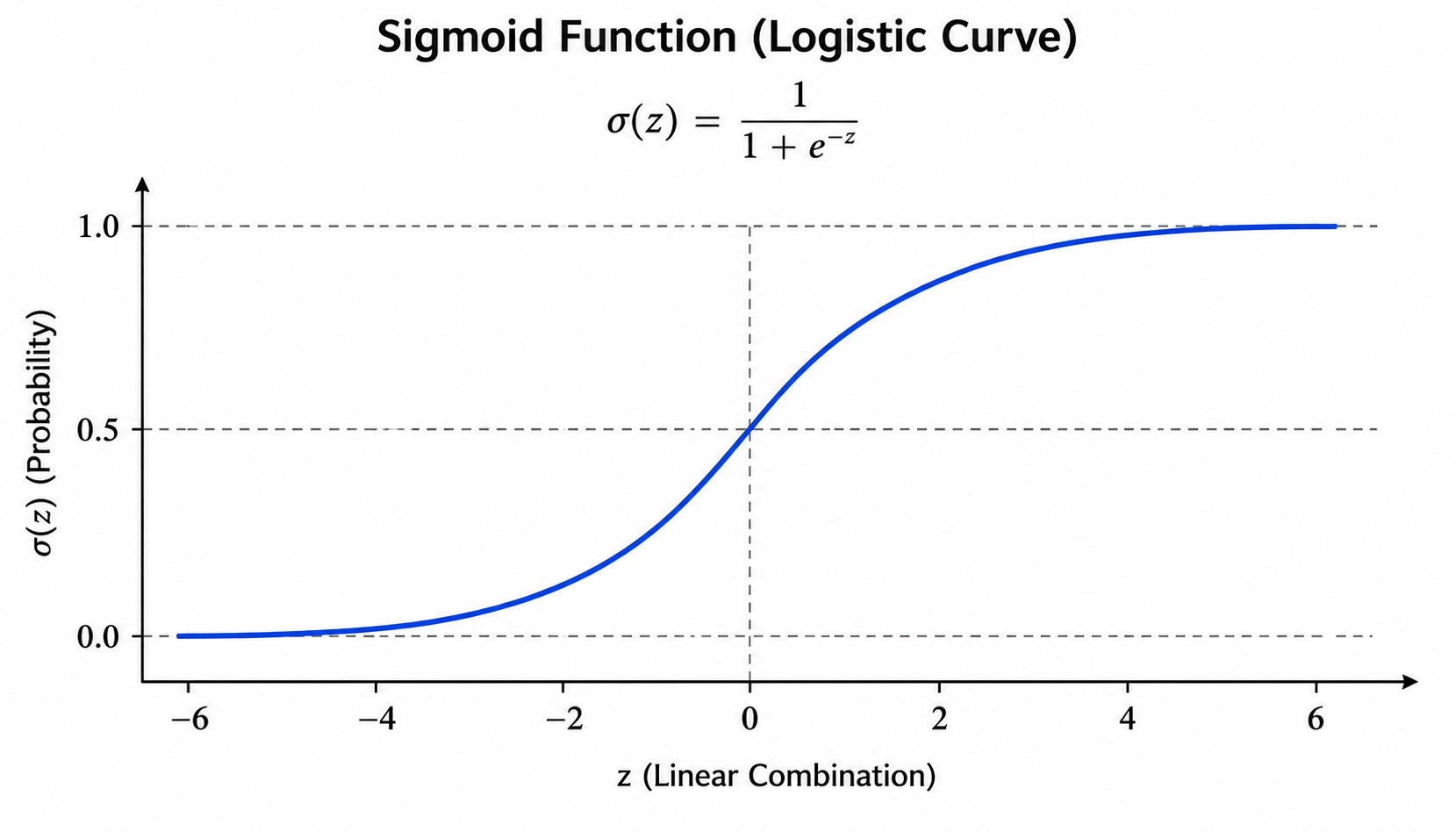
Output always remains:
Between 0 and 1
This makes it suitable for classification problems.
Classification Decision
Usually:
If probability >= 0.5 → Class 1
If probability < 0.5 → Class 0
Example Dataset
| Study Hours | Pass |
|---|---|
| 1 | 0 |
| 2 | 0 |
| 3 | 0 |
| 4 | 1 |
| 5 | 1 |
| 6 | 1 |
Where:
-
0 = Fail
-
1 = Pass
How Logistic Regression Learns
The algorithm:
-
Learns patterns from data
-
Finds decision boundary
-
Predicts probabilities
-
Classifies outputs
Decision Boundary
A decision boundary separates classes.
Example:
Study Hours < 4 → Fail
Study Hours >= 4 → Pass
Suppose:
z = -4 + 1.5x
Predict for:
x = 4
Step 1: Calculate z
z = -4 + 1.5(4)
z = -4 + 6
z = 2
Step 2: Apply Sigmoid Function
Formula:
P(y) = 1 / (1 + e^-z)
Substitute:
P(y) = 1 / (1 + e^-2)
Approximate value:
P(y) ≈ 0.88
Final Prediction
Since:
0.88 > 0.5
Prediction becomes:
Class = 1 (Pass)
Practical Example Using Python
Step 1: Import Libraries
import pandas as pd
from sklearn.linear_model import LogisticRegression
Step 2: Create Dataset
data = {
    "Hours": [1, 2, 3, 4, 5, 6],
    "Pass":  [0, 0, 0, 1, 1, 1]
}

df = pd.DataFrame(data)

print(df)
Step 3: Define Features and Target
X = df[["Hours"]]

y = df["Pass"]
Step 4: Train Model
model = LogisticRegression()

model.fit(X, y)
Step 5: Predict Class
Predict for:
Hours = 4
prediction = model.predict([[4]])

print(prediction)
Expected Output
[1]
Step 6: Predict Probability
probability = model.predict_proba([[4]])

print(probability)
Example Output
[[0.12 0.88]]
Meaning:
-
12% probability of Fail
-
88% probability of Pass
Understanding predict_proba()
Output format:
[Probability of Class 0, Probability of Class 1]
Advantages
-
Simple and fast
-
Works well for binary classification
-
Produces probability output
-
Easy to interpret
Limitations
-
Works best for linear decision boundaries
-
Sensitive to outliers
-
Not suitable for highly complex data
Real-World Applications
| Industry | Usage |
|---|---|
| Healthcare | Disease Prediction |
| Banking | Fraud Detection |
| Education | Pass/Fail Prediction |
| Marketing | Customer Purchase Prediction |
Important Points
1. Logistic Regression is used for classification problems.
2. Output is probability between 0 and 1.
3. Sigmoid function converts values into probabilities.
4. Decision boundary separates classes.
5. Logistic Regression is widely used for binary classification.
Summary
Logistic Regression is a supervised learning classification algorithm used to predict categorical outcomes. It uses the sigmoid function to convert predictions into probabilities and is commonly used for binary classification problems such as spam detection, disease prediction, and pass/fail prediction.
Keywords
Logistic Regression, Logistic Regression in Machine Learning, Classification Algorithm, Binary Classification, Sigmoid Function, Logistic Function, Probability Prediction, Binary Classifier, Supervised Learning Classification, Classification using Python, Logistic Regression using Scikit Learn, Machine Learning Classification, Decision Boundary, Predict Probability, Binary Outcome Prediction