
Single Layer Perceptron
Before learning Multi-Layer Perceptrons and Neural Networks, it is important to understand the Single Layer Perceptron, which is the simplest neural network model.
It was introduced by Frank Rosenblatt in 1958 and is considered the foundation of modern neural networks.
What is a Single Layer Perceptron?
A Single Layer Perceptron is a supervised learning algorithm used for binary classification.
Its goal is:
Learn a linear decision boundary that separates two classes.
It is one of the earliest machine learning classification algorithms.
Biological Inspiration
The perceptron is inspired by the human brain neuron.
Biological neuron:
Inputs
   ↓
Neuron
   ↓
Output
Perceptron:
Features
   ↓
Weighted Sum
   ↓
Activation Function
   ↓
Prediction
Structure of Single Layer Perceptron
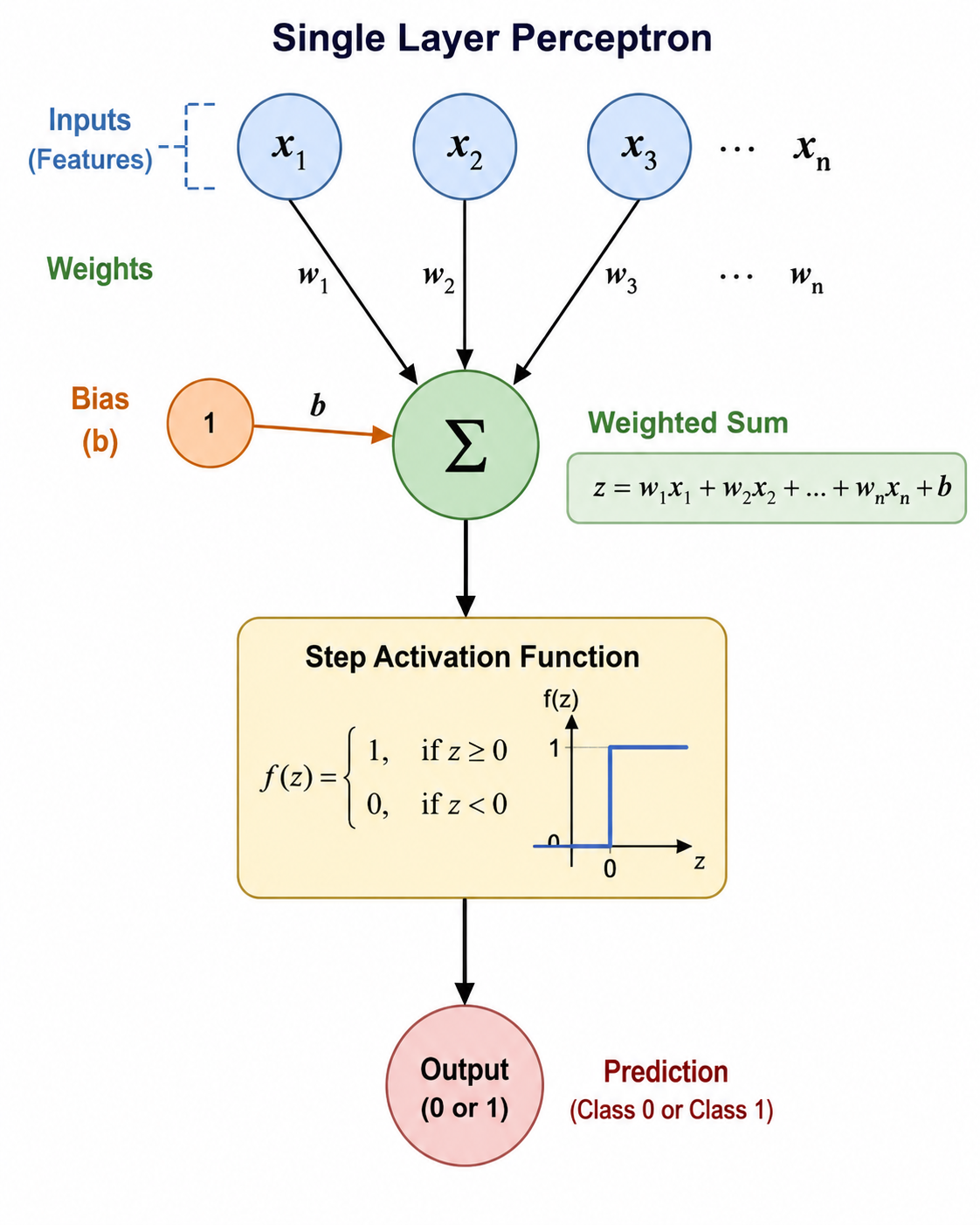
Where:
x1,x2,x3 = Inputs
w1,w2,w3 = Weights
b         = Bias
The Single Layer Perceptron processes input features through a series of steps to make a binary classification prediction. Each input feature (x₁, x₂, x₃, ..., xₙ) is multiplied by its corresponding weight (w₁, w₂, w₃, ..., wₙ), which represents the importance of that feature. A bias term (b) is also added to the weighted inputs.
The perceptron then computes the weighted sum:
z = w1x1 + w2x2 +⋯ + wnxn+b
This weighted sum is passed through a Step Activation Function, which acts as a decision-maker. If the value of zz is greater than or equal to zero, the perceptron outputs 1; otherwise, it outputs 0.
Thus, the perceptron converts multiple input features into a single binary prediction, making it suitable for simple classification tasks where data can be separated using a straight-line decision boundary.
How Perceptron Works
The perceptron performs three steps:
Step 1: Weighted Sum
Calculate:
z = w1x1 + w2x2 +⋯ + wnxn+b
This combines all input features.
Step 2: Apply Activation Function
The perceptron uses a Step Function.
If z ≥ 0 → Output = 1

If z < 0 → Output = 0
Step 3: Generate Prediction
The output becomes the predicted class.
Example:
Output = 1 → Positive Class

Output = 0 → Negative Class
Example
Suppose:
| Feature | Value |
|---|---|
| x1 | 2 |
| x2 | 3 |
Weights:
w1 = 1
w2 = 2
Bias:
b = -4
Calculate Weighted Sum
z=(1)(2)+(2)(3)−4
z=2+6−4
Apply Step Function
z = 4 ≥ 0
Therefore:
Output = 1
Prediction:
Class 1
Learning Process
Initially:
Weights are random
The perceptron predicts a class.
Then:
Compare Prediction
       ↓
Calculate Error
       ↓
Update Weights
       ↓
Improve Boundary
This process repeats until classification errors become minimal.
Perceptron Learning Rule
Weight update formula:
wnew=wold+η(y−ŷ)x
Where:
η      = Learning Rate
y      = Actual Output
ŷ      = Predicted Output
x      = Input Feature
Example of Weight Update
Suppose:
Actual Output = 1
Predicted Output = 0
Learning Rate = 0.1
Input = 2
Current Weight = 0.5
Update:
The weight increases because the model made a mistake.
Decision Boundary
The perceptron creates a linear decision boundary.
Example:
Class A | Class B
The boundary is always:
Straight Line
Therefore:
A Single Layer Perceptron can only solve linearly separable problems.
Limitation: XOR Problem
Consider:
| x1 | x2 | Output |
|---|---|---|
| 0 | 0 | 0 |
| 0 | 1 | 1 |
| 1 | 0 | 1 |
| 1 | 1 | 0 |
This is the XOR problem.
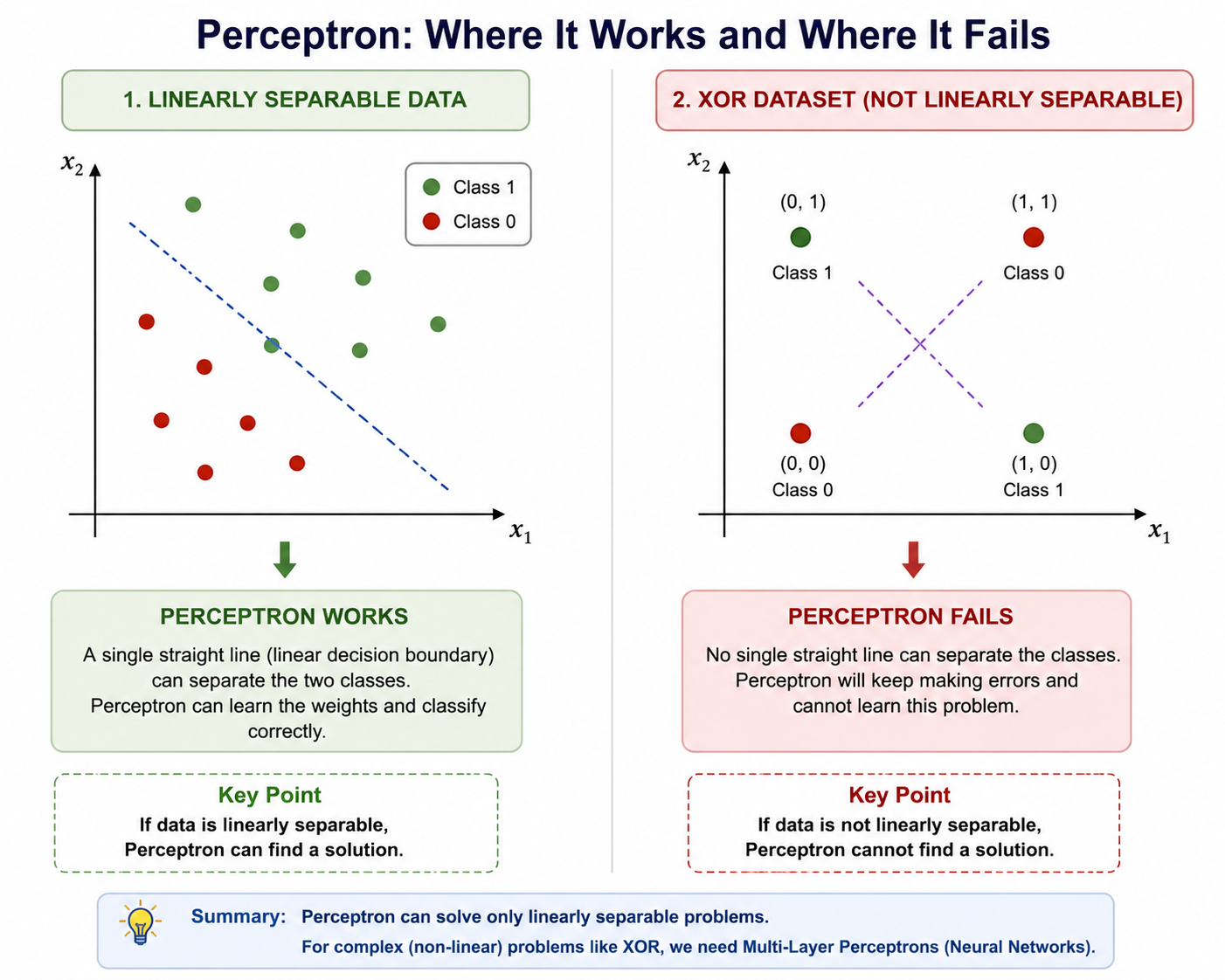
No single straight line can separate these classes.
Therefore:
Single Layer Perceptron fails
This limitation led to the development of Multi-Layer Perceptrons.
Applications
- Binary classification
- Pattern recognition
- Character recognition
- Basic neural network learning
- Educational understanding of neural networks
Advantages
- Simple to understand
- Fast training
- Easy implementation
- Foundation of neural networks
Limitations
- Works only for linearly separable data
- Cannot solve XOR problem
- Limited learning capability
- Less powerful than modern neural networks
Python Implementation
from sklearn.linear_model import Perceptron

X = [[1,1],[2,2],[4,4],[5,5]]
y = [0,0,1,1]

model = Perceptron()

model.fit(X,y)

prediction = model.predict([[3,3]])

print(prediction)
Important Points
- Single Layer Perceptron is the simplest neural network.
- It performs binary classification.
- It uses weighted inputs and a bias.
- The activation function is typically a step function.
- The learning rule updates weights based on prediction errors.
- It creates a linear decision boundary.
- It works only for linearly separable datasets.
- It cannot solve the XOR problem.
- It is the foundation of modern neural networks.
Keywords
Single Layer Perceptron, Perceptron Learning Rule, Artificial Neuron, Step Function, Linear Classification, Binary Classification, Weight Update, Decision Boundary, Neural Network Fundamentals, XOR Problem